The Worshipful Company of Launderers

About Us

The Worshipful Company of Launderers

Master Election 2009

 The Master - Murray Simpson


 A brief History of the 89th Livery Company of The City of London. 

Although one of the oldest crafts and professions in the world, the Launderers had no recognition as a worthy member of the of The City of London Livery until after a momentous, if slightly inauspicious, meeting when thirty two interested and influential Launderers met together with the object of pursuing the long and arduous path to achieving ‘Livery’ status.

That was in 1957 but it was not until three years later, that 32 members of the laundry and associated industries approved the ordinances and formally constituted themselves as the Company of Launderers, that the journey to full City Livery status could commence in earnest.  

But first some brief words about the aims and purposes of the Livery as an institution dedicated to the improvement and indeed betterment of the craft, trade and profession of Launderer and Cleaner.

English trades and crafts had formed themselves into associations or Guilds as long ago as Saxon times between the 7th and 9th Centuries, but it was not until after the Norman Conquest in the 11th and 12th Centuries that the early Guilds began to exert quite remarkable economic and political power in the realm.  

The ancient Trade Guilds were dedicated to the maintenance of quality standards of work, the relief of distress caused by sickness or misfortune to a member and they were governed by very strict rules of conduct. Guild members had a monopoly of any particular trade or craft in the City thus expulsion from a Guild for any reason – usually monetary problems, sharp practice, or failure to maintain work standards – meant that the culprit was deprived of his ability to attract new work and he was forced to remove himself to a town where tradesmen could work as ‘freemen’ outside the jurisdiction of their former Guild. 

From these early beginnings arose a close relationship with the Crown and in the mid 14th Century, ‘Charters’ were granted to certain Guilds, for example, The Merchant Taylors, which not only provided the Monarchy with huge revenues but also assured the King of the support of the entire commercial class represented by the Guilds. From these charters the Livery Companies were created and confirmed in a position of real power over their membership and over their members’ work. 

The ‘Twelve Great Companies’ of senior Livery Companies thus emerged and established for themselves a strict order of precedence - following the lead of The Mercers Company

Strict precedence in seniority was a major item of discord within the numerous Livery Companies now established and this came to a head in 1483 when a long-running dispute between the Skinners  and Merchant Taylors  was settled by a compromise which ruled that the Skinners should be ranked 6th in 1484 and the Merchant Taylors 6th in the subsequent and alternate years. This arrangement still holds good today and has given rise to the expression ‘all at sixes and sevens’ when describing chaotic yet simple problems affecting any particular situation. 

Several other well-known phrases or sayings have come down from Livery activities including: ‘Baker’s Dozen’ meaning the practice adopted by bakers of adding a thirteenth roll or loaf to an order so that there was no risk of being challenged for ‘short measure’. ‘Hall Marks’ arose from the practice of the relevant Livery Companies of marking silver and gold items as proof of the assay standard of the assessed quality. Similarly the expulsion of a Guild or Livery member for whatever reason gave rise to the expression of ‘Being sent to Coventry’. Coventry was a ‘free’ trade town and membership of a Livery was not necessary to attract work if resident there. 

The economic importance of the numerous Livery Companies to the growth of the City of London  and indeed to the entire nation and especially to the Crown is not to be underestimated. In days prior to the 19th Century and the rise of Parliamentary Government, ruling Monarchs relied on taxation of trades and professions to finance foreign wars.

The financial strength of the Livery Companies was critical to these adventures and the Monarchy was intricately bound in to the successful growth of the Companies and this symbiotic relationship is readily seen in the frequency and number of Royal Charters and other benefits bestowed on the medieval Livery Companies.

Such a relationship saw the rise of the political and economic power of the City of London and is one of the major factors which have led to the current pre-eminence of the City as the leading centre of world financial power. This is the underlying historical background to the vibrant story which exists behind every Livery Company

Most, if not quite all, are part of an unbroken thread of commercial life which stretches back over a thousand years. This was a principal reason behind the clear determination of the 32 members who met in 1957 to decide to try and achieve Livery status for the ‘Launderers of London’ – that phrase used in the Freedom of London Certificate, presented to all persons on becoming Freemen of the Company, a necessary step before any aspiring member of the Livery is accepted as a Liveryman of the Worshipful Company.

Subsequently, on February 23 1960 the original 32 aspiring members approved the ‘Ordinances’ of the proposed Company and formally constituted themselves as the Company of Launderers at Tallow Chandlers Hall.

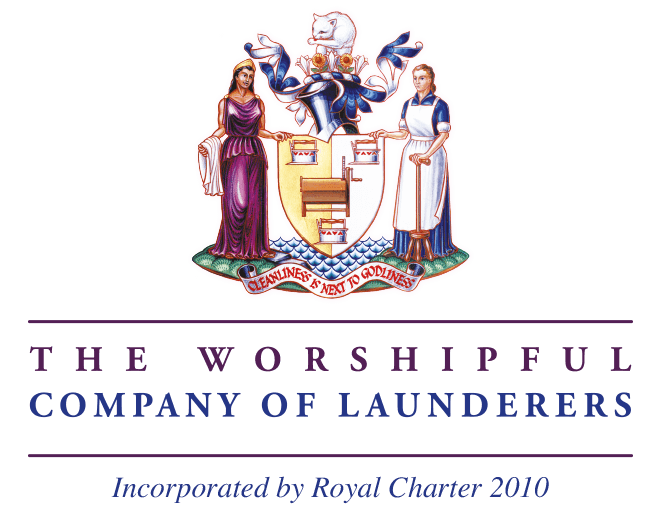
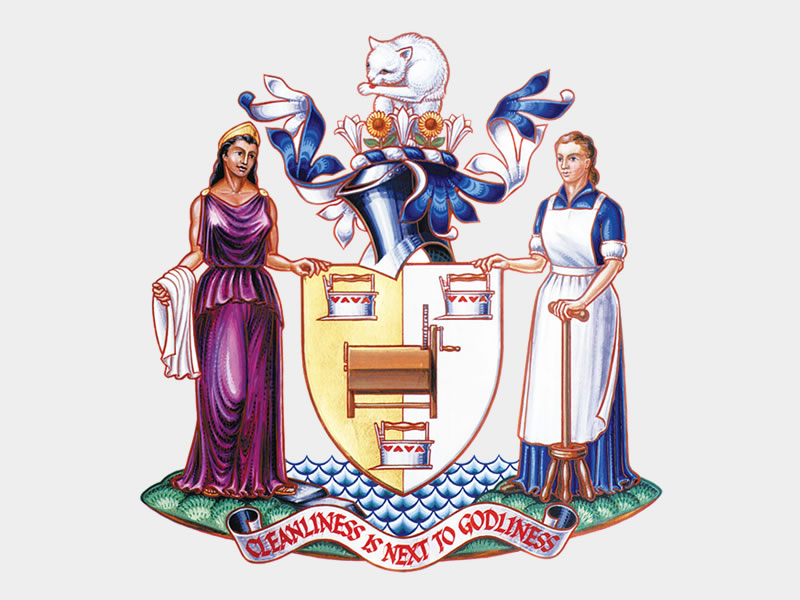
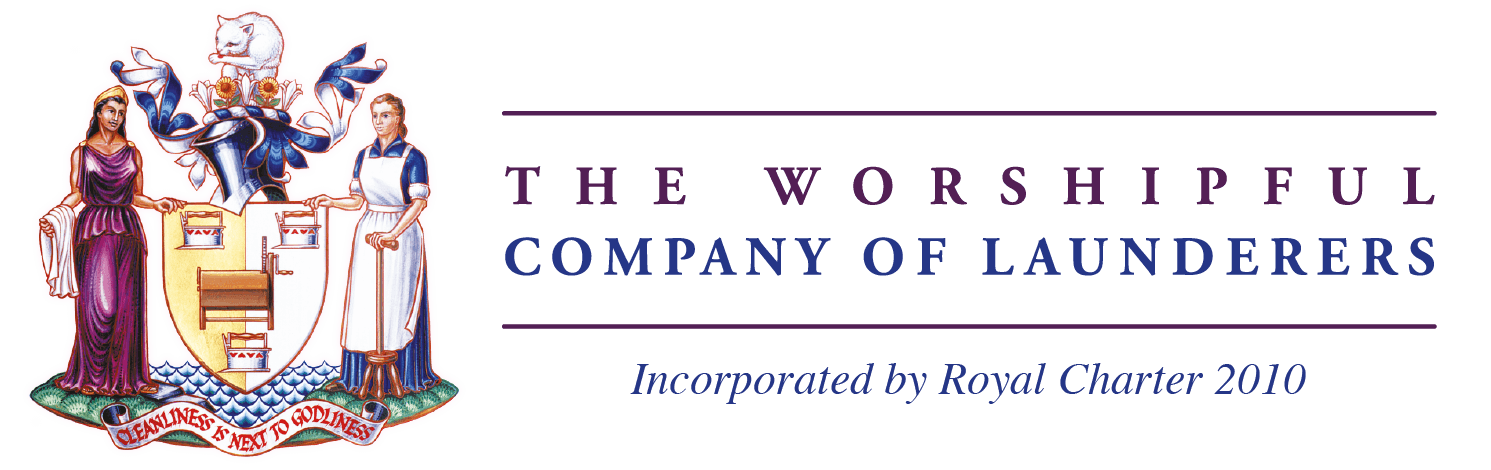
In 1964 the Royal College of Heralds  made a ‘Grant of Arms’ to the Company and this armorial crest brings together several symbolic as well as real elements of the Livery’s history. Central to the design is Henry Sidgier’s patented washing machine of 1782, as well as symbolic depictions of a domestic cat – the cleanest of all animals - surrounded by lilies and sunflowers – symbols of the launderer’s ambition to provide purity, warmth and brightness to their customers.

Also depicted are: Princess Nausicaa from Homer’s Odyssey and an eighteenth century washerwoman carrying a washing dolly; both these representing the practices and ancient status of the Laundrycraft. Beneath the symbolic references on the crest is the Livery motto ‘Cleanliness is next to Godliness’, which neatly combines a saying from the Jewish Holy Talmud with the frequent quotation of that phrase in his sermons by the renowned Methodist Preacher, John Wesley.  

Twenty one years after the inaugural meeting of 1957, full Livery status was granted to the Launderers at a specially convened meeting of the Aldermen of the City of London on March 10th 1978; it had been a long road but the journey was surely worth the effort. The Worshipful Company of Launderers thus became the 89th Livery Company of the City of London and now numbers more than two hundred and fifty Liverymen on its roll.

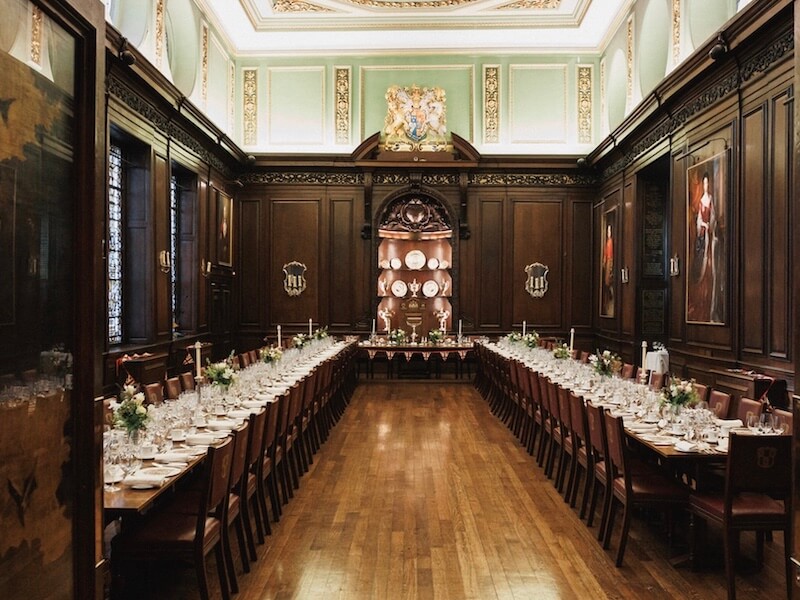
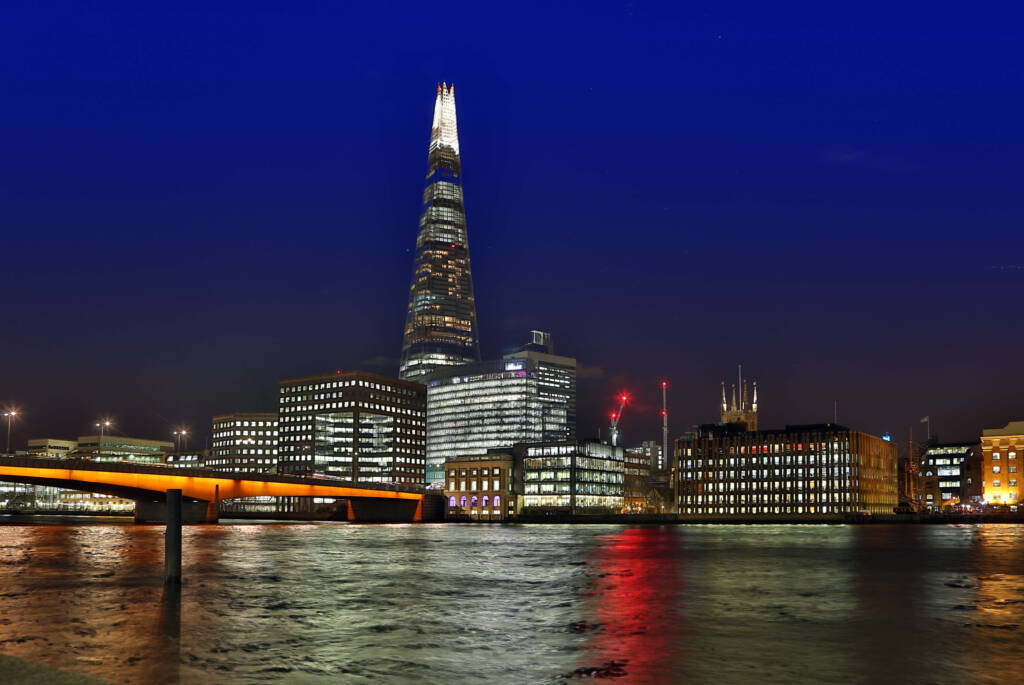
The Company is well-founded and securely established in the Thames-side Hall  which is shared with the Glaziers Company and the Company of Scientific Instrument Makers. Three professions and Liveries which, by fortunate circumstance cover many thousands of years of worthy endeavour and widely acknowledged skills.  

Membership of the Worshipful Company of Launderers is by invitation and subsequent ‘viva’ interview with the candidate by the Master and Wardens of the Company. Membership is a personal honour, recognising the contribution of that individual to the laundry and associated industries. In return the successful applicant is expected to participate fully in the activities of the Company, as well as contribute to the charitable Trusts and Benefices operated by the Company.  

Numerous formal and informal events take place each year, some at Launderers Hall itself, many others in the City or at Southwark Cathedral, which may be called ‘our Parish Church, as the Company has close associations with the Cathedral and whose Sub-Dean is our current Honorary Chaplain. These are informative events, frequently ‘sold out’ and  always convivial and unusually free of overly enthusiastic ‘commercial’ pressures’ they are also a pleasurable way of reflecting on the simple fact that the other Livery Members present have all, in some way, contributed effectively and in many cases very significantly, to the industry which all believe in and indeed honour. 

Annual ‘Quarterage’ Subscriptions are levied once a year to all Liverymen and new candidates for admission to the Livery are always welcomed by the Court.

Further information about the Livery and how to offer yourself as a candidate please call The Clerk to the Worshipful Company, Mrs Jacqueline Polek on 0207 378 1430 or by email clerk.launderers@btconnect.com or discuss your interest in joining with any Liveryman known personally to you.


Launderers Hall
9 Montague Close
London Bridge
SE1 9DD
Tel: 020 7378 1430
Email us